
One
He is a poet. A man of his time, enlightened, able to influence the time he belongs in. He has seen the world as a poet, through the lens of history’s epics. He wanted to memorialize the ever-present, to listen to the voices of the past. He had wanted to know: How did the Bengalis became Bengalis. How did these peoples find completion after a thousand years, starting from the age of the Charyas to now. He has shown all these in his poetry: how the Aryans, Mongoloids, and the dark skinned Dravidians merged seamlessly into our blood, how Persians and Arabs, the Portuguese and English Sahibs had remained in our bodies and in the workings of our myth. How this copper skin toiled with sweat. He had said, “Born under the sun and raised by the rains/ We have built ourselves through the centuries/ a copper-ed race, we have arrived thus.” — This was how he had shaped his literature. And surely Muhammad Nurul Huda is that poet; inseparable today from the language of his people. A poet of the nation.
If one wanted to create a portrait of this poet, they would do better to be in presence of Nurul Huda. They must follow his voice, his restlessness and stillness, his creativity and meditative persona. They must follow the awakening through slumber, his movements will convey that he is no ordinary person, but a poet. Someone connected to Michael, to Rabindranath, to Nazrul and Jibanananda, to the unique depths of Bengali literature. He is the inheritor of all poets, great and mediocre. A legacy for future poets. He has been a keen student of English and a learned teacher. He had wanted to present the unfinished works of his predecessors in new light. Shakespeare’s Sycorax gains physicality through his hand, becomes an image of post-colonial literature. A new post-colonialist discourse materializes through his version. Instead of falling back on modernism, he introduced a radical discourse to modernism. For him, modernity was continuous, and post-modernism only the intermediate stop. Today, we live amidst globalism, where the literature of diaspora increasingly becomes mainstream. Here, even the greetings of a first meeting can have the internationalism of a “Good day”. When the nation needed an outline to map their identity, he has ably provided one, “Bangladesh encompasses as far as Bengali is spoken.” We know, Bengalis live all over the world. Like a flag-carrying ship, we represent the culture beyond the capitals. His poetry bear the history and anthropology of his people. Yet he will not deny the contribution of other cultures, whether that be by force. “I look like a Portuguese pirate!” he would call out. Through the mixture of his race, his poetry, too, claims intertextuality. Nothing was original, he merely wanted to be a basic human.
His poetry is the story of the old world; By recounting it, his poetry extends to us: people who will become ancient in the future; Hence the use of popular mythology and the tendency to mythologize recent subjects can be seen in his poetry. Muhammad Nurul Huda’s poetry is characterized elsewhere as different from contemporary poets. Rather than the romantic lyricism of the modern poet, the classic poise of the epics gained prominence. So he is keen to have a separate and holistic consciousness for each book. He reconsidered the fact that Modern Bangla poetry had abandoned the overall consciousness of a poetic text. The basic trend in Muhammad Nurul Huda’s poetry is his sense of history; A sense of time derived from the gestures of the cosmos, the biological existence and consequences of human beings, which he deemed fit to record.
What makes him unique is that he has brought out the primitive form of this human establishment through poetry, he has discovered the possibilities as well as the terrible beauty of this. What SM Sultan discovered in painting, he did in poetry. In Sultan’s painting we see the muscular man of the agrarian society and his struggles against that society. Eventually the idea of a pantisocracy can be invented. He has also been active in building a legacy of modern man’s frustrations, exhaustion, skepticism, disgust and pessimism, yet always striving for virtue.
His poetry transcends the reader’s perceptions of their limits to knowledge. He is versatile, his books are markedly different from one another. Though, they all culminate toward one goal. One can recognize this through his use of book titles. Procession to Dravida. Fiery Earthen. We are a Bronze race.
Nothing, however, is final. The diversity of humans are reflected in his work. It is not the dharma of the poet to remain stilted in the same philosophy over the ages. He softly sings the ghazals of water, as he resurrects Mujib – Jesus like – from the abode of the former, through a disconsolate and warring image of Bengal. Essentially, his poetry is the poetry to be human. It is in the spirit of Chandidas and Nazrul, which do not care for religion nor caste. “Beliefs, caste and non-castes/We all have the ancient right to live as fundamentally humans.”
Two
Now he is old enough; he has matured wise. Twenty five years ago, a few young and old poets had gone to him on the occasion of his fiftieth birthday, forcing him to speak up his thoughts. In that September evening of 1998, the interviewers had wanted to ask: “How do you see these fifty years of life – flourishing or withering? He said, “I walked before I could stand, ran before I could walk, flying away before I could run – in this restlessness I had passed away the last fifty years. I still see myself as a coastal, young child, danguli in hand, out on the fields on a sunny afternoon. I have seen many things: from the moon-filled nights of my adolescence to the neon of my middle age. 90 percent of the people in my society are at a worse position than I am. The poet is never content. He still reaches out for his desired beam of light. He throws up a storm in the locality, singing, “O Chandmama, mark my forehead!”
He had once announced he will abandon poetry. Whatever gets done through poetry? Rather, it is better to work for the betterment of the people. It is better, he presumed, to stop writing and take up homeopathy. “With homeopathy, I am able to directly be of assistance. I cannot do that with poetry. I can’t help myself either. He had to carry on not-writing for a long time. Later, however he returned. He had done both, too, terming it poemopathy.
It is in such a way that Nurul Huda traps himself in the questions of his hunter-interviewers. He answers away with patience and hope. All those who came to him where younger and his dear ones. Some were poets, some were journalists. Yet they were all versed readers and interpreters and asked questions with anticipation.
The interviewers asked. “Tell us about being a poet of our nationality.”
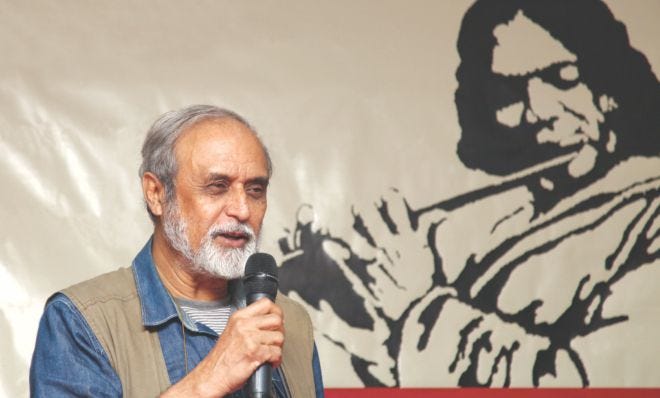
He said, my first three books were clearly paving the way for a conscious look at our nationality. In Shobhajatra Dravidar Proti (1975), I had written about the realities of our country. I had started this trend of awareness quite early in the poetry of Bangladesh. I raised these ideas at a 1972 literary conference. I had participated in the mass movement of ’69. Asad was shot right next to me. I have tried to write of all these using the diction I had.”
Some, doubtful, asked, “Bengalis are a mixed race, yet you term them the race of the copper-skinned.”
The poet claimed that the use of the word has to be taken with context. Black, white, copper-ed. The essence of the term in the poem was that of the working class.
He answered without much hesitation. The crises of the twentieth and twenty-first century, literary theory, the dawn of the machines — all these found their way into their questions. Even his personal matters he did not want to avoid, for those issues are quite important to bear on the source of literature. He has been an expert in both eastern and western mythology. In matters of literature and teaching in the class-room, he has professed great expertise in English literature. Even in the field of translation, he has had quite the range. Therefore these interviews will not only be a tool to know the poet more, but also be of aid in understanding and applying the instruments that make literature worth it. He was inclined to uncover the loss of literature, opining that before Buddadeb Bose had translated Baudelaire, the latter’s modernity had not touched us, even though by that time it was too old already. Literature remaining out of bounds make for lost generations. “I age, but Murtoza Bashir’s portrait of mine do not. I consistently hide so many of myself in the folds of age.” Perhaps, in so many questions, we, too, find that Nurul Huda has remained concealed.
A poet’s life is his poetry. It is the history of his time. All his collisions with the outer and inner world that delights and torments him, he wants to pen it down for posterity. But language is difficult to wrangle down. It is depended on time and interpretation. There is perennially an ambiguity that adds to the mystery of the poet. To have a conversation with the poet, therefore, is to attempt to resolve this mystery. But is not always easy work. Confronted with the poet, the interviewers’ commentary become that of the reader. And this is why this book is so important, for Poet Nurul Huda has brought about a literary audience from the ground up, people who increasingly saw themselves as part of his copper-skinned peoples.